

by Emma Kennedy
Certified strength and conditioning coach
Qualified personal trainer and fitness trainer with fitness nutrition. Certified strength and conditioning coach. Emma is passionate about the importance of strength and cardio training. Her classes improve your technique and knowledge, while providing a strong workout that will help you get the maximum benefit from your chosen sport or activity.
It is one of the most common questions that we get asked and for good reason. However, your right weight is personal and depends on your individual strength, your exercise history and the specific muscle mass required for the move you’re performing.
What weights do I need to start?
Start with what you have. Our exercises can be performed with a small selection of equipment. Always start with weights that feels manageable. We suggest starting with 2kg (or bodyweight) and building up from there. Focus on learning to do the exercises properly.
Why lifting heavier matters
The technique we use is known as progressive overload – gradually increasing the weight as your strength improves.
The trick is not to lift as heavy as possible, but to gradually increase the weight as your body becomes stronger, because if you continue using a weight that has become easy, you’re no longer giving your muscles the same level of challenge to progress your strength.
Our qualified instructors always provide guidance on weight selection for each exercise, so that you select a weight that appropriately challenges the specific muscle mass involved in the movement.
Three common weight mistakes (and how to avoid them)
1. Expecting fixed weight numbers
In our coaching, we recommend light, medium, or heavy weights for each exercise rather than prescribing an actual weight. While this might sound broad at first, we do it intentionally, because a blanket weight range doesn’t account for individual differences. More importantly, weights should always match the target muscle mass for that specific exercise.
Why “heavy” changes by movement: A “heavy” weight for a shoulder press looks very different to a “heavy” weight for a squat, because a shoulder press uses smaller upper-body muscles (like the deltoids), so a “heavy” choice might be 5kg dumbbell. In a squat, where you are using your body’s largest, strongest muscle groups (your glutes and quads), a “heavy” choice might be 10kg or more. Both choices feel equally challenging to your body, but the actual weight is vastly different.
2. Sacrificing form for ego
An easy way to check if you’ve chosen the right weight is whether you can maintain good alignment for all your repetitions. For instance, don’t opt for an 8kg dumbbell because you can do three decent reps if everything after that starts looking skewiff. The last rep in any set should be challenging, but your form must remain clean. This ensures that you fatigue the target muscle, resulting in your body adapting and becoming stronger for the tasks you ask of it.
3. Lifting until it’s impossible
We recommend picking a weight that makes the last couple of repetitions of a set challenging, but not impossible. We are trying to fatigue your muscles, not inflate your ego! If you try to carry out movements (like core work or upper-body presses) with a weight that is too heavy, your body will automatically cheat by recruiting secondary muscles in your back and neck instead. That leads to strain rather than strength.
How to match your weight to any exercise
The overarching rule is simple: select a load that appropriately challenges the specific muscle mass involved in the movement.
Below are general guidelines for how to apply light, medium, or heavy loads across your routine (the movements listed are just common examples to illustrate the concept, not an exhaustive list):
Use LIGHT weights for smaller muscle mass
- The principle: Exercises that isolate smaller muscle groups (or involve raising your arms above shoulder height) require lighter loads. This ensures you work that specific smaller muscle mass without arching your spine, straining your neck, or losing your core alignment.
- Example movements: Straight-arm pulses, lateral arm raises, front shoulder raises, or rear-delt flies.
Use MEDIUM weights for combined movements and core stabilizers
- The principle: These exercises recruit a moderate amount of muscle mass or require your core stabilizer muscles to hold you steady while working your upper and lower body together. A medium weight challenges your strength while maintaining control.
- Example movements: Weighted lunges, squats with an upper-body component, renegade rows, or dumbbell thrusters (because they combine multiple muscle groups across the full body).
Use HEAVY weights for large muscle groups
- The principle: Moves that are less explosive and recruit your body’s largest muscle groups require heavier weights to be effective. The muscles in your lower body are some of the strongest in your entire frame. To properly fatigue them – and stimulate changes in endurance, strength, and bone density – requires heavier loads that you can feel working right from your very first rep.
- Example movements: Deadlifts, Romanian deadlifts, barbell hip thrusts, and heavy squat variations.
The five-point self-check
Before starting any set, ask yourself these five quick questions to confirm you have selected the right weight for your body:
- Can I clearly feel the target muscle working?
- Can I move through this exercise with good form?
- Will I be able to keep good form in every rep?
- Will I be able to complete all the sets?
- Do I feel like I’m being genuinely challenged by the end?
If you answered “no” to questions 1–4, drop to a lighter weight. If you answered “no” to question 5, it’s time to safely step up to a heavier weight.
Use these starting guidelines to help you gauge where to begin:
If you are new to workouts and the weights area:
Focus on establishing great technique, joint control and confidence.
- Barbell: 12kg
- Dumbbells: Between 2kg and 5kg
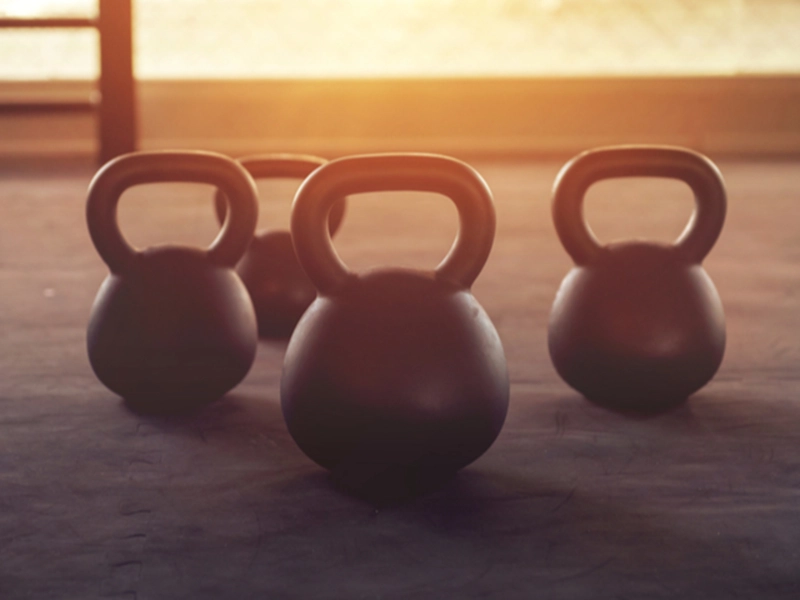
- Kettlebells: Between 4kg and 10kg
If you have base strength (from regular cardio and bodyweight work):
You have established baseline movement patterns and lift regularly.
- Barbell: 14kg (light)
- Dumbbells: Between 4kg and 10kg
- Kettlebells: Between 6kg and 14kg
If you can already squat your own bodyweight (or close):
You are an experienced lifter comfortable with heavy compound loading.
- Barbell: 20kg (light)
- Dumbbells: Between 6kg and 10kg+
- Kettlebells: Between 8kg and 18kg+
Listen to your body
Remember that your strength can fluctuate day to day depending on sleep, stress and recovery. Always prioritize form over the number printed on the weight plate – that is how we keep you strong, capable and injury-free for life!