

by Clare Kennedy
Level 4 personal trainer UCD, Certified nutritionist with MAC Nutrition
My passion is helping people to build and maintain strength, by making fitness accessible and enjoyable particularly for those in midlife. I want people to feel confident, love who they see in the mirror, and fully enjoy their next chapter. Our classes are built around real lives and goals, making strength and healthy habits simple and enjoyable to follow.
Here is a truth that doesn’t get said enough: you can build real strength and muscle at virtually any age. Whether you are in your 40s, 60s, or beyond, your body remains remarkably adaptable. Countless studies prove that older adults can experience significant gains in muscle mass, bone density and functional capacity through resistance training. The biological machinery to build a stronger, more resilient physique doesn’t shut down as the calendar turns – it just changes its operating rules.
If you want to stay stronger for longer, the secret isn’t train harder like you were 20 again; it’s learning how to adapt your recovery.
Why recovery changes as we age
To understand why you need to approach recovery differently, it helps to look under the hood at what changes biologically over time:
1. Slower protein synthesis
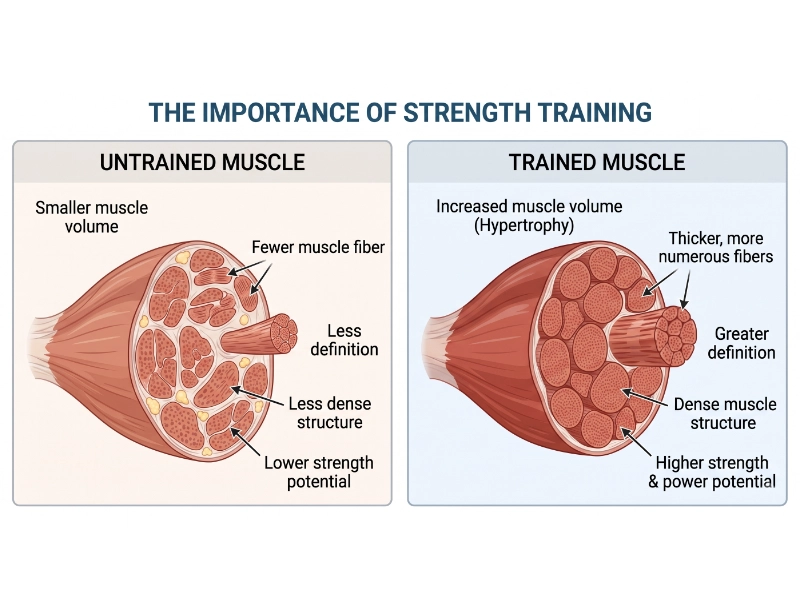
Muscle hypertrophy (growth) happens when your body repairs the micro-tears created in muscle fibres during exercise. As we age, our bodies experience a phenomenon known as anabolic resistance – a reduction in the efficiency of muscle protein synthesis. You can still repair and build muscle, but your tissue requires slightly longer to complete the process.
2. Reduced collagen and connective tissue elasticity
While your muscles might feel ready for another intense workout after 48 hours, your tendons, ligaments and joints often lag behind. Collagen turnover slows down as we get older, making connective tissues stiffer and more vulnerable to overuse injuries if not given proper downtime.
3. Shifts in hormonal profiles
Natural declines in key anabolic hormones like growth hormone, testosterone and estrogen mean your body takes longer to clear metabolic waste and rebuild tissues after heavy strain.
How to work with your body, not against it
Making continuous gains while staying injury-free requires shifting from a “more work” mindset to a “better recovery” strategy.
|
Recovery pillar |
What changes as you age |
Action |
|
Training frequency |
High-frequency daily beatdowns lead to systemic fatigue and connective tissue strain. |
Prioritise 2–4 targeted strength sessions per week, allowing 48–72 hours between working the same muscle group. |
|
Protein intake |
Higher thresholds are required to trigger muscle protein synthesis due to anabolic resistance. |
Aim for 25–40 grams of high-quality protein per meal, ensuring balanced distribution across the day. |
|
Sleep quality |
Sleep cycles tend to shorten, but deep sleep remains essential for tissue repair and growth hormone release. |
Protect a strict 7–9-hour sleep window, keeping your room dark, cool, and free of blue light before bed. |
|
Active recovery |
Passive rest (sitting on the couch) can lead to joint stiffness and sluggish circulation. |
Incorporate light movement on off-days – walking, swimming, or gentle mobility work – to deliver blood flow to recovering tissues. |
The ultimate goal: Longevity and vitality
Train smarter, not harder. Muscle growth doesn’t happen during your workout; the workout is simply the stimulus. The growth happens when you sleep, eat, and rest.
By giving recovery the respect it deserves, you allow your body to fully adapt to every session. You keep your joints pain-free, your energy high, and your trajectory moving upward – ensuring you stay stronger for life.